
The Line Tangle, or the Black Fire of Dream
Text / Wei Guangji
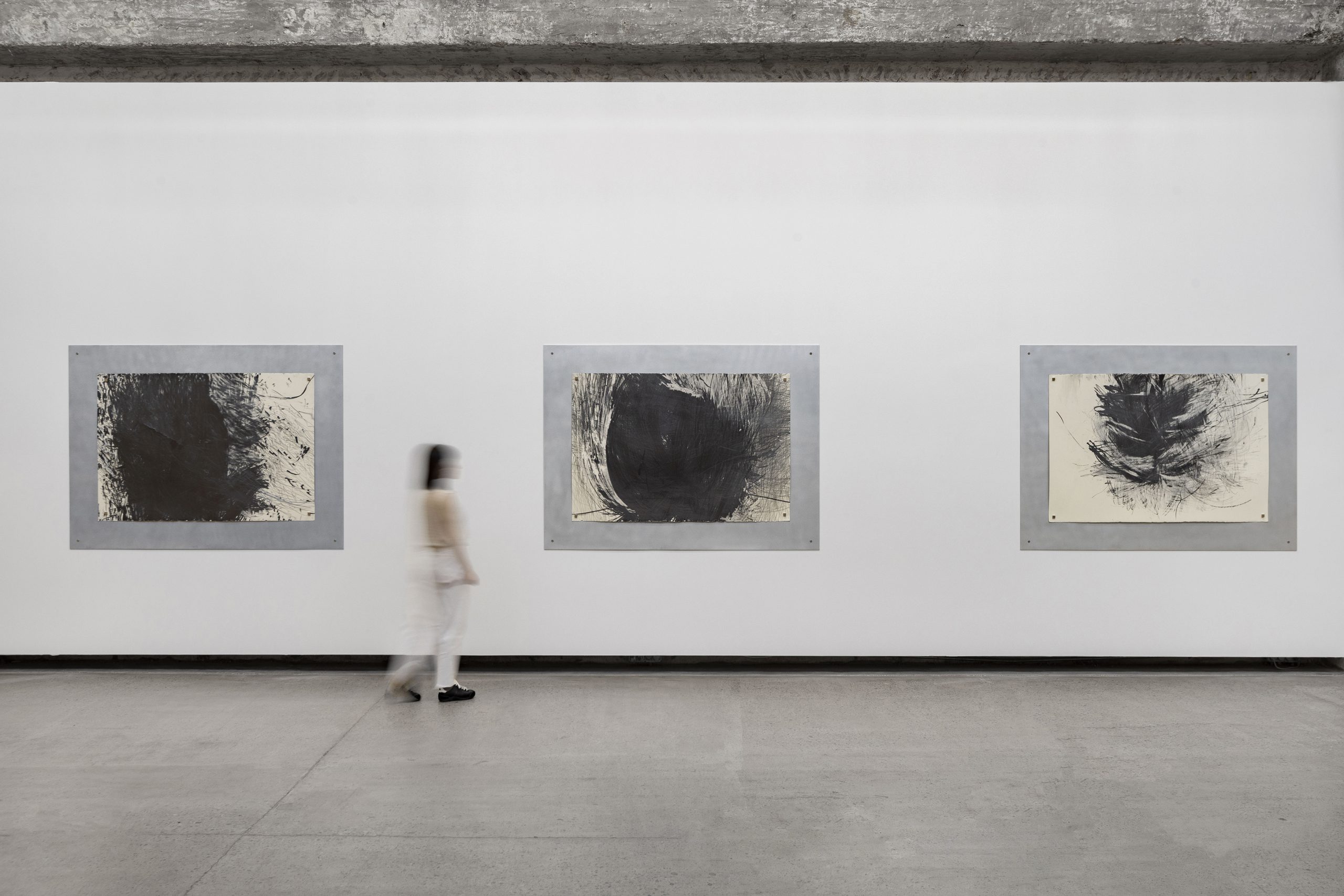
When the pinecone first emerged faintly from the paper, it created an eternal mystery: the mystery of a tangle of thread that can never be unraveled, forever trembling. In truth, there was no pinecone on the paper—only endless coils of line, winding and twisting in cycles, now sparse, now dense, now dark, now faint. They clustered together, tightly wrapping around some invisible, shadowy core. But what was that core? How did it draw these tangled threads into itself, making the unbridled lines spin, dance, and swirl around it in frenzy, as though all visible lines grew endlessly out of it? So there exists within the tangle a hidden gravitational field. It attracts and pulls these lines that strain outward, reaching toward ever-greater distances; it restrains their urge to sprawl at will—or rather, every freely moving line ultimately returns to some unknown origin, surging irresistibly toward its destined end. And in the region where they are about to arrive, at the most urgent speed, they form a heavy, stifling density, a black curtain that blocks the gaze and clogs space. At this moment, the adventure of the line becomes impossible to advance; lines that once moved with ease at the periphery sink into a rigid morass. But what traps these nimble lines is the lines themselves—more precisely, their interweaving and entanglement. In this stricken place, the breathing of the lines grows calm, their bodies grow thick, they cease their futile struggle and resistance, they no longer flow, no longer even tremble. The clamor of the lines has fallen into the deepest silence. Mute, the line becomes its own most merciless binding. Yet in the lightless prison, line and line will silently form the friendship of the blind. The vast swarm of lines, with an immovable thickness, laboriously surrounds the secret they jointly keep, a secret that cannot be shown. This secret, like a death curse breathed from a dark mouth, instantly freezes the active lines with its icy breath. In swarms, the lines begin to congeal, to transform, to generate ink stains, clots, planes. The line is about to depart from its existence as line, to leave drawing and tracing behind and turn toward smearing and washing. The line’s hesitation, its wavering, will become the ink’s steadiness, its resolve; the line’s solitude, its drifting, will be swallowed by the ink’s density, its solidarity. A single lonely line, wandering everywhere, is like a stray drop of water that will ultimately return in despair to the boundless sea of thick ink—and that abyss of ink is itself piled up from the remains of countless exhausted lines. The tangle embraces and guards with such passion this silent end, this unspoken funeral, and transforms its repressed mourning into the wildest dance, the most carefree farewell, the most untrammeled escape. And these waving, escaping lines, like hints accidentally released from a labyrinth, still connect to and point toward that mystery rumbling faintly like thunder through layer upon layer of dark clouds: the mystery of the pinecone, the mystery of the still life, the mystery of the object.
Pinecone, only pinecone. For three years, he looked at nothing but pinecones, painted nothing but pinecones. A tiny pinecone, under the sustained attention of his gaze, began slowly to swell and grow, until its volume was enough to fill a huge sheet of paper. So he was not looking at the pinecone; he was nourishing it with his gaze, letting it grow like a living thing. He infused it with his thought—his gaze was his thought. He studied the pinecone persistently, studied this inconspicuous, dried, hard, light, many-angled thing, this thing that seemed to him almost impossible to see through, this enigmatic thing. For the object stubbornly guards its own secret, hiding the essence of what it is to be an object. Beneath its visible, perceptible surface, the abyss of the object’s existence has long lain quietly. To look at an object is to cross the obvious surface and enter this bottomless abyss, until the gaze is seized, drawn in, completely captivated, and finally sinks into the depths within—this is the object’s unbreakable heart, its eternal, unchanging night. Thus, to look at an object means to converse with that silent heart, to wander in that vast darkness, to abandon and surrender the gaze entirely, letting it lose itself in the gloom of the abyss. And so the gaze scatters, the eyes empty, and the object openly discloses its heart, exposing its deeply hidden interior. A boundless night unfurls slowly before him, and in the dimness the various elements of objecthood creep out like cautious nocturnal animals: its warm texture, its delicate grain, its faint fragrance, its undoused vitality—all dissolve into particles of night, released and dispersed without direction or boundary. They form the air of night, a pervasive black mist. Thus the object absorbs the gaze, saturates itself with the gaze. Under the subtle, transformative power of looking, as long as one gazes long enough, even the hardest shell of an object becomes soft and porous; even the clearest, most distinct outline grows chaotic and blurred. And so the object, together with the gaze, ruptures, collapses, volatilizes, disperses. It leaves behind a wisp of smoke, a cloud of fog, a patch of dust; it becomes a ruin, a residual image, a phantom. He looks at the object; the object is always there. But what is there is never the object—at least never the solid, self-evident, sharply defined object—but always the back of the object that can never be clearly seen, an ambiguous image in which reality and illusion blur, the object’s shadow and night. This indescribable night, this part that is immanent in the object yet exceeds it, he calls the soul. He, contemplator of the soul, paints portraits of still lifes.
Everything is line. What is visible is line; what is invisible is still line. Line runs through everything, constitutes everything. Line weaves, and line unravels. Line reveals, and line conceals. Line is always a mark difficult to judge, a threshold of ambiguity. Line is the road to another world, a secret invitation. An invitation from the painting—his painting.
When the object trembles in the gaze, about to shatter, the lines that bind and entangle it loosen and come untied. A dense object begins to radiate outward and pour forth the countless lines that constitute its substance. Released lines, free lines, flamboyant lines, impassioned lines: not a single line can remain calm, just as not a single string can wholly escape the law of oscillation. The object appears to vibrate continuously, as though an unceasing earthquake were at work inside it. Under one shock after another, the object is shaken apart; it disintegrates and loosens into lines. But it has not yet been completely defeated. Even as it falls apart, it strains with all its strength to maintain its existence as an object, barely gathering the lines that have not yet escaped its magnetic field—for the object itself is an unstable magnetic field. In the disturbance of magnetism, the lines have long since bent and fallen into disorder, interwoven into densely packed tangles. The tangle is the object’s resistance to disintegration, its unconscious form of persistence. There is no longer any object—only the object’s remnants, the oscillating phantom it leaves on the retina, its faint, ethereal traces: that is, the tangle of lines struggling, swirling, and warring in the tension between the poles of attraction and repulsion. Yet the center wrapped by the tangle is always empty, as the occasionally revealed gaps in the impenetrable curtain of lines disclose. This is the vacuum created by the object’s absence—or rather, the abyss split open within the object. All lines are drawn toward this all-devouring black hole formed by the object’s collapse: the end of the object, the origin of the painting.
Even the most insignificant object has its own vast universe. When it is eroded, pierced, and shattered by the gaze, it disperses into a universe of lines. The crisscrossing lines are precisely the reenactment of the gaze’s trajectory. But they are not rays of light. Light may illuminate the object’s exterior, but only a gaze equally dim, a blind vision, can penetrate its soul. What travels and steals through the night sky hatched by the object is a lightless gaze, a dark light stripped of all color by the black hole. The tangle is a nebula woven from dark light, an extinguished galaxy. In this all-black universe, the object’s soul cannot be seen with the eyes; it can only be touched with the hand. The hand that holds the line sees nothing—as Derrida said, drawing is blind.
How to make a blind painting? How to close one’s eyes and see? For him, it is through dream. Dream is also a kind of seeing; dream has always already been dreaming.
He dreamed of the pinecone. Day after day, in the daytime studio, waiting for the object’s night to descend quietly. Painting is the hour of dream. With his hands he touches and embraces the dream that can never be grasped. Dream is his eyes, the color of the painting, and also the object’s thought. A dream without end, like a night without end. Recurrence, cycle, repetition. Pinecone, pinecone, pinecone. Only pinecone. Day after day, at last, dream and dream overlap: one dream intrudes into another, many dreams condense into the same dream, one dream disguises itself as another, the same dream clones countless more dreams. In the confusion of old dreams and new, he cannot tell which is which, nor does he need to distinguish, nor remember. He merely watches quietly, forgets, lets the dream transform without reason. Because of this generation, the shifting dreams have no determinate image. He cannot dream any image; he only dreams his own dream. His dream? He does not even know whose dream it is. Dream belongs to no one. He has no consciousness of the dream, just as the hand has no dominion over the line. As soon as he tries to look, he is already within the dream. As soon as he raises his hand, a line is already guiding the brush where to go. Dream has become the climate of his studio, has become the studio itself. But dream is, after all, part of the night, and his studio can only be a darkroom of the gaze. So he paints—that is, he dreams. Dream connects to the world behind the object, that obscure universe of tangled silk threads suited to blind sight. So he dreams—that is, he weaves a net. Dream is nothing but the net that binds the soul and blindfolds the eyes, that tangle of thread. He dreamed of the labyrinthine net heavy with the shadows of lines.
He no longer dreamed of the pinecone.
Lines everywhere. Line draws boundaries and also gives form; line is the most ancient trace of drawing. He is obsessed with line. But he is not eager to establish any boundary or form. On the contrary, line is an impulse that dissolves everything bounded or formed: in his hands, line does not give but withdraws; line does not represent but erases. Sometimes the line is so hesitant, so wavering, as though the moment it appears it cannot wait to disappear, as though its very existence were a questioning of itself. To resist this fate of disappearance, the line must undergo the harshest trial, must confirm its own purposiveness through repeated ordeals. In regions heavy with doubt, lines are continually born and then sublated. Before a line can confirm itself, it is covered and denied by a newly arrived line. Lines tirelessly replicate themselves, and every stroke that falls is both a birth and a blow. Lines become so suspicious, so restless, so calculating, that every newborn line carries the mission of subversion and overthrow, and every surviving line is merely the trace of lines destroyed and cleared away. No line can be born whole; no line can truly reach its ideal destination. Line, what a futile existence. Line, finding no rest in endless conspiracy. The deepest, darkest tangle: the graveyard of lines, the limbo of lines.
There are light lines and heavy lines; slender lines and thick lines; continuous lines and broken lines. But whatever kind of line it is, line has nothing to do with shaping the form of an object. On the contrary, line seizes and destroys any possibility of form in the most primitive, most savage way. When line is no longer form, line becomes material—that is, it becomes black substance, becomes the solid, substantial flesh that fills a body, dense flesh, flesh in blocks. But flesh means energy, means intensity and force. Force especially: for line, even the most ordinary line, conveys pure force the instant it is drawn. Such force does not come from the painter’s hand, driven by another body; it belongs to the line itself, is even the line’s essence, the line’s desire. So what is line? Line is force with no outlet, desire that leaves a trace, will inscribed inward. Yet line often restrains its own force. To be intimate with the plane, it slides cautiously, tremblingly, scattering like raindrops; but once it falls into doubt about itself, line turns toward irrepressible force. It becomes merciless hail, plummeting meteorites, crashing violently into the once tranquil space with which it had lingered. The tangle becomes pitted and scarred, strewn with craters and shell holes. Dried mud, a battlefield covered with wounds. But the storm of force has not yet subsided; it blows in denser, more chaotic lines. Force is the line’s fury, the line’s self-negation and cancellation: in the most extreme case, line takes the pitch-black tangle that can contain no line at all as the site where force manifests. On this dark matter where it no longer has any place to dwell, it marks the trajectory of force’s movement, and this faintly glimmering trace, like a meteor streaking past, merely bears witness to the line’s successful disappearance into the night. When a pure black line cuts recklessly toward a still blacker swarm of lines, black and black annihilate each other in violent collision. Black fades, dims; black generates gray, even white. Line carves itself with such frenzy that it hollows itself out. And so the line’s presence is its absence, the line’s fullness is its exhaustion; line and line perish together. Thus line repeats itself, erases itself, until it breaks through the strata of the tangle. It will constitute an impact, a crushing, a friction, a cutting, a splitting, a penetration of the ground. Ultimately, it is violence inflicted on white paper, an imprint branded into the skin of paper, a scar tearing open the face of the painting. Line: the sting of the paper’s surface.
… He dreamed of the pinecone. In some unknown winter, on a path through the wild, he picked up that nameless pinecone: abandoned, ignored, overlooked, buried, a seed of the future. Every cone is an invisible tree. Endlessly growing tree. A giant tree. Perhaps a dense forest. Round, thick, immovable, suddenly lifting off, roots and tendrils together, leaving gravity, suspended, drifting, looming—the shadow of the sky, an alien spacecraft. A black sun wrapped in cotton thread, a head cut off and scorched, wearing thorns, steaming with hot smoke. A faceless mask. A hole in the snow. Ash covered by snow, a burned pinecone. Crawling through the overgrown dark forest, creeping, pushing aside fallen branches, tearing away spiderwebs—but the midges cannot be driven off, the lingering buzzing harasses and entangles, like the clutter of life, with no clean ground anywhere. So be it: endless ears of wheat to gather, dust filling the sky, mixed with dry grass, wheat stalks, cotton fluff. A pitch-black door, standing open there, a tombstone. Swimming toward it, swarms of photosensitive creatures, migrating schools of fish, carrying seeds, nostalgia, desire, along the luminous path in the dark water, surging in. Denser and denser, blacker and blacker, until submerged, unable to breathe. The memory of the womb. The illusion of drowning, a deathbed confession. Impossible to speak; with the sinking vortex, open the mouth and spit out the silence bound by pain. Still, something can be said—only not loudly, only hoarsely humming from the throat an endless, indistinct murmur of chatter. Impossible to stop, impossible to end: this wind, this rain, this flood, this plain, this ravine, this nest, this wooden stake, this head, this eye. Not enough—the tangle rolling larger and larger, continuing its messy, filthy, utterly confused, utterly methodless, sloppy, wretched writing, the writing of dream…
Line, omnipresent line.
Line, from pencil, from charcoal, from graphite. It comes from another substance both hard and soft, from the wearing down, decomposition, and depletion of the object, from the darkness within the object, from the absolute night released by the object. Line draws out this invisible night. With the ardor of white paper, it ignites the graphite, illuminates the black of carbon. Line is the charred trace of carbon; every line drawn means striking a black flame on the paper. To paint is to set fire with line. The charcoal stick is his match; the ink block is his flint. In continuous rubbing and collision, line kindles a fire, a dark fierce fire, a fire of night. But night also has its own radiance: when the smoothness of ink reflects the faint light of the outside world, the fire of line becomes a silver dance. Where the burning is most intense, the clash of line against line even produces a layer of cinder, a scar of the tangle, as though the sharpest line had already scorched the paper with its blade. The paper begins to convulse, to contract; it must defend itself, must extinguish the fire. And so a column of light tears open the heavy night, several ripples of water attack unexpectedly from the edges of the black fire, pressing against the heat of the ink flame, struggling to erase, wash, and quench, covering the scorched earth of line with a thin wing, a wisp of down, a layer of white snow. Or rather, letting the paper find a moment to breathe under the strict surveillance of the tangle, letting it recover its own quiet and innocence from the ink’s encroachment. Lines shatter, blur; lines driven out by the daylight surging from the white paper become residual traces of ink clots, ashes of cinder, drifting, swirling, sometimes rekindling, generating still more powerful traces of line. Fire does not easily go out. As Heraclitus’s saying goes, this is an ever-living fire. Through unending line, the painting transmits this undying black fire, in order to burn out the true face of the object.
About the Author:
Wei Guangji is an associate professor at the School of Liberal Arts, Renmin University of China. He has served as editor-in-chief of Revolt Against Poetry: The Collected Works of Antonin Artaud, The Last Witness: For Paul Celan, The Eternal Witness: A Blanchot Reader, and Giacometti: The Narrow Path, among others. He is the author of Silence and Death: A Sketch of Blanchot’s Thought.
